Arthur’s Seat
One DayArthur’s Seat is a summit above Edinburgh, approached in these scenes by way of Salisbury Crags and Holyrood Park. Its significance lies not only in its view over the city but in its recurrence: Dexter Mayhew first climbs it with Tilly Killick and Emma Morley, then returns years later with his daughter Jasmine. The mountain becomes a shared route through different stages of his life, shifting from an overlooked landmark to a setting for memory and father-daughter intimacy.
Setting and Approach
The route is introduced from Rankeillor Street, where Salisbury Crags loom at the end of the street and point the way towards Arthur’s Seat. The ascent is presented as accessible rather than forbidding. Dexter assures Emma that a child could manage it, though the later climb with Jasmine makes the difference between his confidence and his physical stamina part of the scene’s humor.
At the summit, the city opens into a sequence of recognizable landmarks. Dexter sees council estates, the spires and crenellations of the Old City beneath the bulk of the castle, and, beyond them, the Firth of Forth in the haze. The view is familiar from picture postcards, yet he has never seen it in person. His usual reluctance to appear impressed gives way to an admission that the panorama is magnificent. The climb thus brings him into direct contact with a part of Edinburgh he had known as an image but not as an experience.
The First Ascent
Tilly proposes the climb after Emma rejects the idea of going to the beach: wearing a swimming costume in front of Dexter feels like an ordeal she cannot face. When Dexter says he has never climbed Arthur’s Seat, both women are astonished. The revelation makes the proposed outing less a routine excursion than an opportunity to see a famous local landmark together for the first time.
Tilly then says that she should probably leave the two of them to their own plans. Emma catches her wink and thinks she could easily lean over and kiss her, but the passage does not turn that possibility into an action. Dexter, brightening, agrees to go with Emma. Fifteen minutes later they are outside in a hazy July morning, with the Crags ahead of them. The brisk change from conversation to movement gives the ascent the quality of a spontaneous shared undertaking.
On the way up, Dexter initially treats the view as an obligation rather than a reward, dismissing the idea that a view is worth stopping for. He eventually pauses, hands on his knees, and turns back towards the city. His understated concession that it is very nice marks a small reversal: the man who resists showing enthusiasm has been won over by what he sees. He and Emma continue towards the summit, still wondering what will happen when they reach it; the episode establishes the climb as an experience of discovery rather than simply a destination.
Return with Jasmine
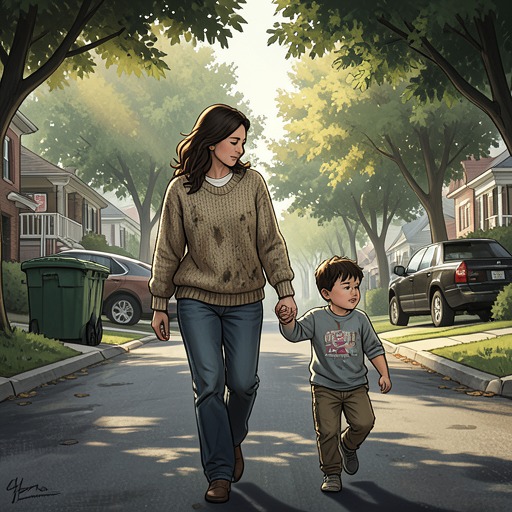
Years later, Dexter brings his seven-and-a-half-year-old daughter to the street where Emma once lived when they were at university, a place he identifies as connected to how they met. The ordinary terraced house offers little to distinguish it from its neighbours, and Dexter questions the point of the nostalgic expedition. His attention shifts when Jasmine points out the granite escarpment at the end of the street. He names it as Salisbury Crags, leading up to Arthur’s Seat, and invites her to climb.
The second ascent reverses the physical balance of the first. Jasmine clambers up the path with far more energy than her father, stopping to laugh at him as he wheezes and sweats below. Dexter blames his lack of grip on his shoes, but they leave the main path and scramble over rocks before reaching the scrubby, rust-coloured plateau. The stone column marking the highest point becomes a pause in the route: Dexter studies the scratchings and inscriptions, half hoping to find his own initials among them. Instead, the names and messages he sees belong to other visitors, registering the summit as a place repeatedly marked by people passing through.
Dexter lifts Jasmine onto the column and points out the castle, the station, the Firth of Forth, Leith, the New Town and Calton Hill, orienting her within the city he once knew as a young man. He dates that earlier life as twenty years before and jokes about being a natural athlete, while Jasmine imitates his wheezing. Their exchange makes the difficult climb a source of play as well as exertion. After setting her down, he swings her beneath his arm; her screaming and laughter extend the physical comedy into a moment of affection.
Memory and Significance
Away from the summit, Dexter and Jasmine find a natural hollow overlooking the city. He lies back with his hands behind his head while she eats salt-and-vinegar crisps and drinks juice. The early start catches up with him, and he begins to feel sleep approaching. In this quieter pause Jasmine asks whether Emma came there too. The question brings the mountain, the earlier university connection and Dexter’s account of the past into the same moment. The supplied passage ends before he answers, leaving the question open rather than confirming Emma’s presence on the earlier climb.
The two ascents give Arthur’s Seat a double place in Dexter’s life. The first makes a postcard view newly real and gives him and Emma a shared excursion; the later one turns the same landscape into a route for showing Jasmine the city and recalling his younger years. The hill remains physically continuous while Dexter’s companions and circumstances change. Its summit offers a broad view, but the scenes’ sharper focus is on what can be passed between people there: a first-hand encounter with the city, a family joke on the path, and a question that reconnects the present to Emma.